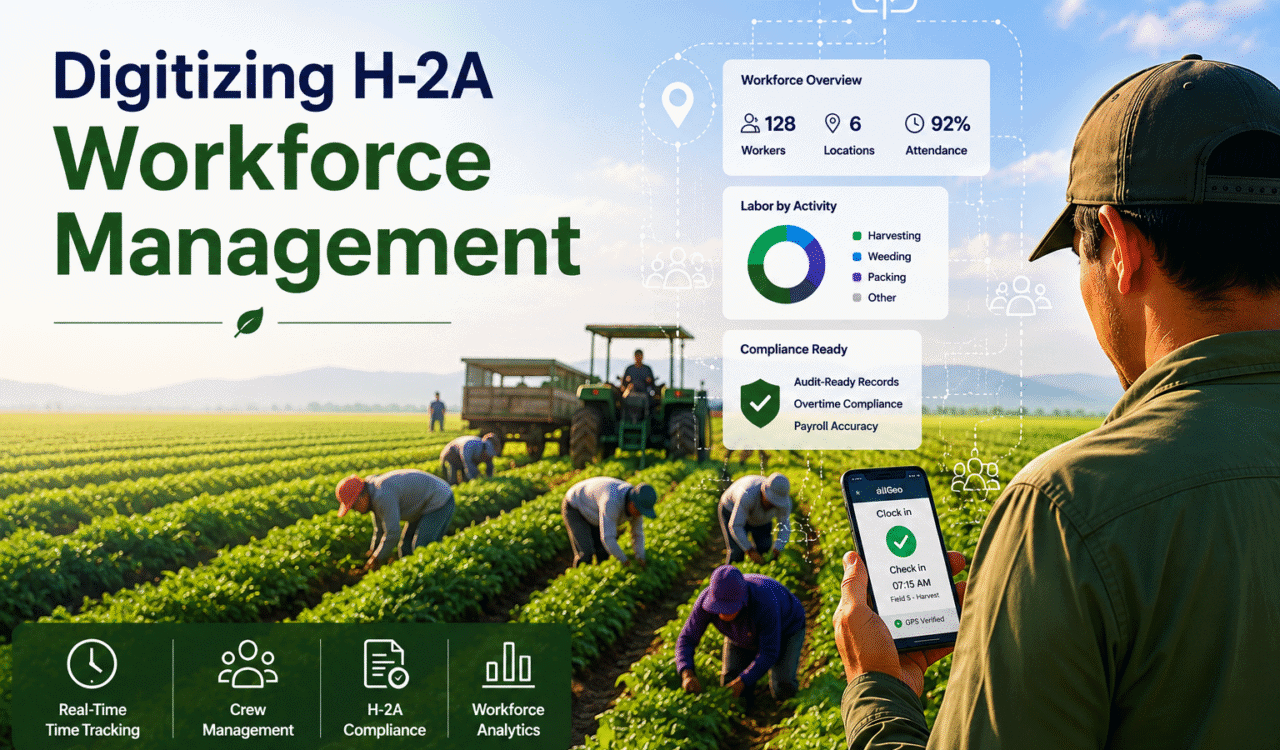
Seasonal labor is the backbone of agricultural operations across the United States. But managing H-2A workers efficiently has become increasingly difficult due to rising compliance requirements, labor shortages, payroll complexity, and limited visibility into field operations.
For many farms, manual processes still dominate workforce management.
Paper timesheets, spreadsheets, disconnected payroll workflows, and inconsistent field reporting create operational inefficiencies and compliance risk.
That was the challenge faced by Kreher’s Farm, a U.S.-based agricultural operation managing seasonal and full-time labor across multiple farm locations.
By implementing allGeo the farm digitized workforce management and gained real-time workforce visibility across field operations.
This blog explains how.
What Is H-2A Workforce Compliance?
The H-2A visa program allows U.S. agricultural employers to hire temporary foreign workers for seasonal agricultural work. However, farms employing H-2A workers must comply with strict labor and payroll regulations.
These requirements often include:
- Accurate time and attendance tracking
- Separation of regular, overtime, break, and travel time
- State-specific overtime calculations
- Weekly signed compliance documentation
- Audit-ready payroll records
- Workforce tracking by job, role, and location
Without digital systems in place, managing compliance manually can create an increased administrative overhead.
Why Manual Workforce Management Creates Compliance Risk
Before implementing allGeo field workforce compliance software, Kreher’s Farm relied heavily on fragmented manual processes for workforce management and payroll preparation.
The farm faced several operational challenges:
- Inaccurate Time Tracking Across Multiple Farm Locations: Tracking work hours, travel time between fields, and overtime manually often resulted in inconsistencies and payroll reconciliation issues.
- Time-Consuming Workforce Time Validation: Payroll teams had to manually review timesheets, verify labor records, and prepare compliance documentation before payroll could be processed.
- Limited Crew Visibility in the Field: Without centralized workforce visibility, supervisors struggled to allocate workers efficiently, track labor hours by crop or activity, reassign crews during operational changes and monitor attendance in real time.
How allGeo Helped Digitize H-2A Workforce Management
To address these challenges, allGeo implemented an integrated solution combining:
1. Mobile Time Tracking With Real-Time Workforce Visibility
The first step was replacing manual time collection with mobile-based workforce time tracking.
Supervisors and workers could clock in and out directly from smartphones or tablets while working in the field.
The system supported:
- GPS-verified time capture
- Real-time attendance visibility
- Workforce tracking by location and activity
- Audit-ready workforce records
Because workforce data was captured in real time, managers gained immediate visibility into who was working, where crews were located, and whether jobsites were staffed as expected.
2. Automated Overtime and Wage Calculations
allGeo helped Kreher’s Farm verify workforce hours, overtime, travel time, and labor rules before payroll runs.
The platform automatically calculated:
- Regular hours
- Overtime hours
- Travel time
- Shift-specific work hours
- Labor allocation by crop and activity
The system was configured to support state-specific overtime requirements, including 52-hour overtime compliance rules.
It reduced manual payroll corrections and improved wage and hour accuracy.
3. Faster Crew Management Across Field Operations
Using allGeo crew management workflows, supervisors could:
- Check in entire crews of 20 to 30 workers from a single device
- Assign workers based on crop and activity
- Reallocate labor dynamically in real time
- Track workforce activity across multiple locations
The platform also supported offline workforce tracking in remote farm environments where internet connectivity was limited.
Data automatically synchronized once connectivity was restored.
4. Structured Mobile Forms for Field Data Capture
allGeo mobile forms and proof-of-work workflows enabled supervisors to capture structured field data directly from mobile devices.
Teams could record:
- Crop-level activities
- Harvesting details
- Weeding tasks
- Job-specific information
- Time-stamped field records
- Worker attestations and signatures
Because records were tied to time, location, and workforce activity, the farm gained audit-ready documentation to support both operational reporting and compliance workflows.
5. Automated H-2A Compliance Documentation
allGeo streamlined the process by automatically generating compliance-ready workforce records.
The platform generated reports containing:
- Worker details
- Hours worked
- Activity breakdowns
- Payroll summaries
- Audit-ready labor records
6. Seamless ADP Payroll Integration
ADP and allGeo integration streamlined the payroll workflows. Instead of manually consolidating spreadsheets and timesheets, payroll teams received validated workforce data directly from the field.
This enabled:
- Employee data synchronization
- Payroll-ready time exports
- Reduced manual payroll entry
- Faster payroll processing
- Improved payroll data accuracy
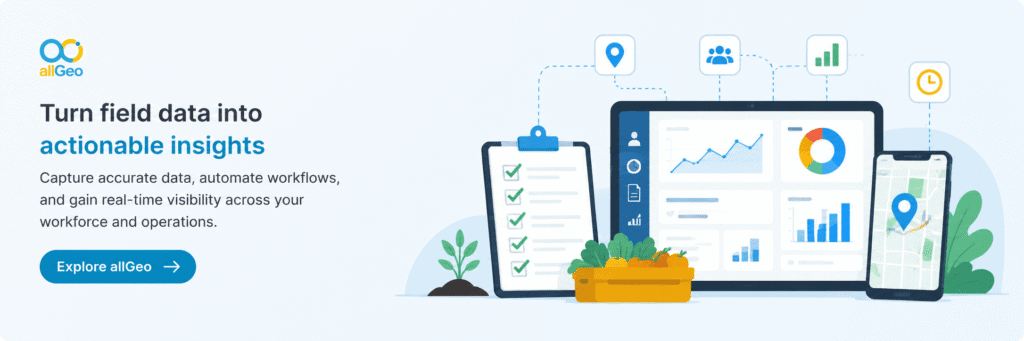
7. Workforce Analytics for Better Labor Planning
One of the biggest long-term advantages of digitizing workforce operations is access to actionable workforce analytics.
Using real-time workforce dashboards, the farm gained visibility into:
- Time spent by crop and activity
- Labor allocation across fields
- Workforce productivity trends
- Operational staffing patterns
Final Thoughts
Managing H-2A labor efficiently requires more than basic time tracking software.
Agricultural businesses need integrated workforce management platforms that connect payroll, compliance, crew management, workforce visibility, and field operations into a single system.
For farms looking to reduce payroll errors, improve workforce visibility, and simplify H-2A compliance, workforce automation can become a significant operational advantage.
Schedule a demo with allGeo to see how your business can benefit with automation.